Introduction
Buyers comparing braided and roll-wrapped construction for carbon fiber hex tube products often ask which process performs better. Public documentation only supports a partial answer to that question. Some structural and manufacturing facts are confirmed for specific product families, while several performance claims that circulate in marketing materials are not backed by verifiable data. This article separates what is actually documented from what remains an open question, then explains how a technical buyer can request comparable, directly relevant information from suppliers instead of relying on general claims about either manufacturing process alone.
What the Available Evidence Confirms
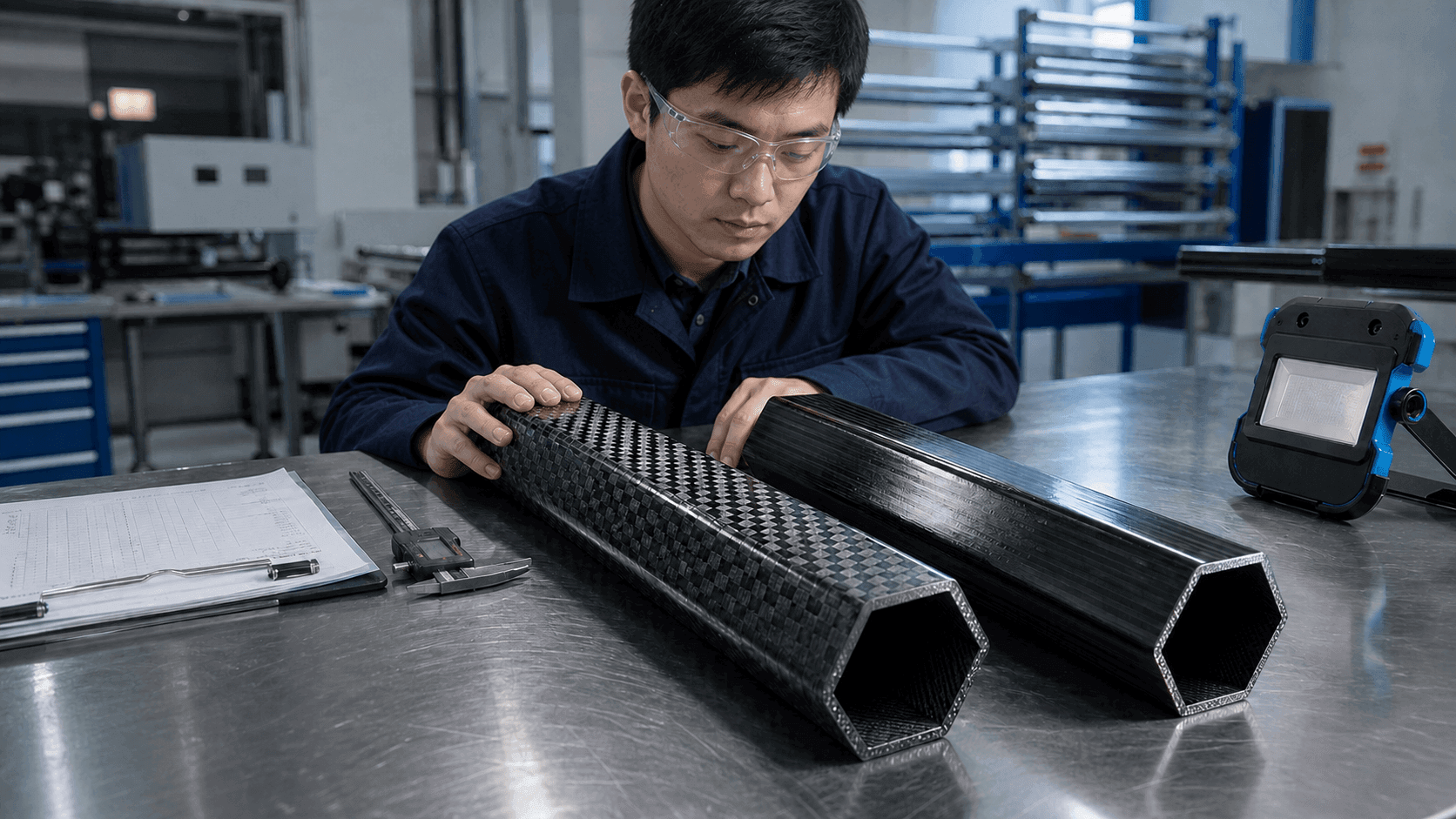
A limited set of facts can be stated with confidence here. Braided hexagonal carbon fiber tubes can be constructed using high-angle carbon fiber braid. At least one documented braided product family is engineered to balance torsional rigidity, bending stiffness, and hoop strength, and that same product family uses a cello-wrapped gloss finish as part of its curing process. Separately, roll-wrapped carbon fiber tubes are commercially available on the market. Hexagonal carbon fiber tube products are also offered in both standard-modulus and high-modulus versions. These five points are the entire confirmed factual basis this article draws on, and every other statement below should be read against that limit rather than treated as an independently verified claim.
What the Evidence Does Not Confirm
Outside those confirmed points, the available documentation does not establish a direct performance comparison between braided and roll-wrapped construction. It does not state that braided architecture is inherently better suited to torsional, bending, or radial loading than roll-wrapped construction, nor does it confirm that roll wrapping allows more flexible control over fiber direction. No ply schedules, resin systems, independent test reports, certifications, pricing, or supplier capabilities are documented in the material this article relies on. Where marketing language asserts a performance advantage for either process, that claim should be treated as unverified until the specific supplier provides supporting data tied to the product actually being quoted, not a general description of the process or a competitor comparison drawn from unrelated product lines.
Braided Construction: Confirmed Information and Open Questions
The confirmed braided product family referenced above uses high-angle braid and targets a balance of torsional rigidity, bending stiffness, and hoop strength, along with a cello-wrapped gloss surface produced during curing rather than applied afterward. Whether this same balance and finish apply to other braided products from the same supplier, or to braided tubing from other suppliers entirely, is not established, so that combination of traits should not be treated as describing braided tubing as a category. Open questions worth raising with a supplier include the exact braid angle used, how that angle relates to the load direction in your application, whether the gloss finish involves any surface treatment relevant to later bonding or coating steps, and whether the same construction is offered consistently across the sizes you need.
Roll-Wrapped Construction: Confirmed Information and Open Questions
Roll-wrapped carbon fiber hex tube products exist and are sold commercially, which is the extent of what is documented here. Ply angles, fiber types, and resin systems used in the roll-wrapping process are not disclosed in the available material. A common industry claim holds that roll wrapping offers more flexible control over fiber orientation for a targeted axial property, but this claim sits outside the confirmed evidence base and should be verified directly with a supplier rather than accepted as a given. Anyone evaluating this construction for axial-load applications should request the specific layup sequence and any related test data before treating a stated performance advantage as settled fact rather than a sales description.
Modulus Grade and Surface Finish
Standard-modulus and high-modulus versions are both documented as available for hexagonal carbon fiber tubing, though the material reviewed here does not indicate whether that split applies to braided tubes, roll-wrapped tubes, or both equally. Composite literature commonly associates higher modulus with reduced elongation at break, which can influence impact behavior, but that relationship should be confirmed against the specific product's own test data rather than assumed to apply universally across brands or grades. On the finish side, a glossy cello-wrapped surface is documented for one product line, but nothing in the available material confirms whether that gloss actually changes surface roughness or whether it functions as an applied coating rather than a byproduct of the resin cure, and this distinction matters when planning any downstream bonding or painting step.
Supplier Comparison Checklist
A practical way to evaluate carbon fiber hex tube suppliers is to request the same categories of information from each one, at matching wall thickness and modulus grade, so the answers can be placed side by side rather than compared loosely. Ask for the braid angle and how it was chosen relative to the intended load direction, the ply orientation and resin system behind any roll-wrapped option, and measured torsional and bending stiffness figures rather than nominal catalog numbers. For surface finish, ask whether pretreatment is needed before bonding or coating, and whether the gloss is inherent to the process or separately applied. A supplier who cannot answer these points in specific terms is offering a marketing description rather than a specification you can design against.
Conclusion
Choosing between braided and roll-wrapped construction for carbon fiber hex tube applications is less about which process is categorically better and more about which supplier can support its claims with data tied to the exact product being quoted. Given the real limits on what is publicly documented, the more reliable path is to request matched, apples-to-apples data from each candidate supplier before weighing torsional, bending, or axial performance, and to treat any unsupported claim of superiority as a prompt for further questions rather than grounds for a purchasing decision on its own.