
Carbon fiber quality control starts with an approved drawing, defined material requirements and clear acceptance criteria. Dimensions, laminate requirements, surface finish and assembly interfaces must be considered together.
At Carbosources, quality requirements form part of the manufacturing review for custom tubes, sheets, rods and CNC-machined components. Inspection scope is defined around the features that affect your part’s fit, function and intended application.
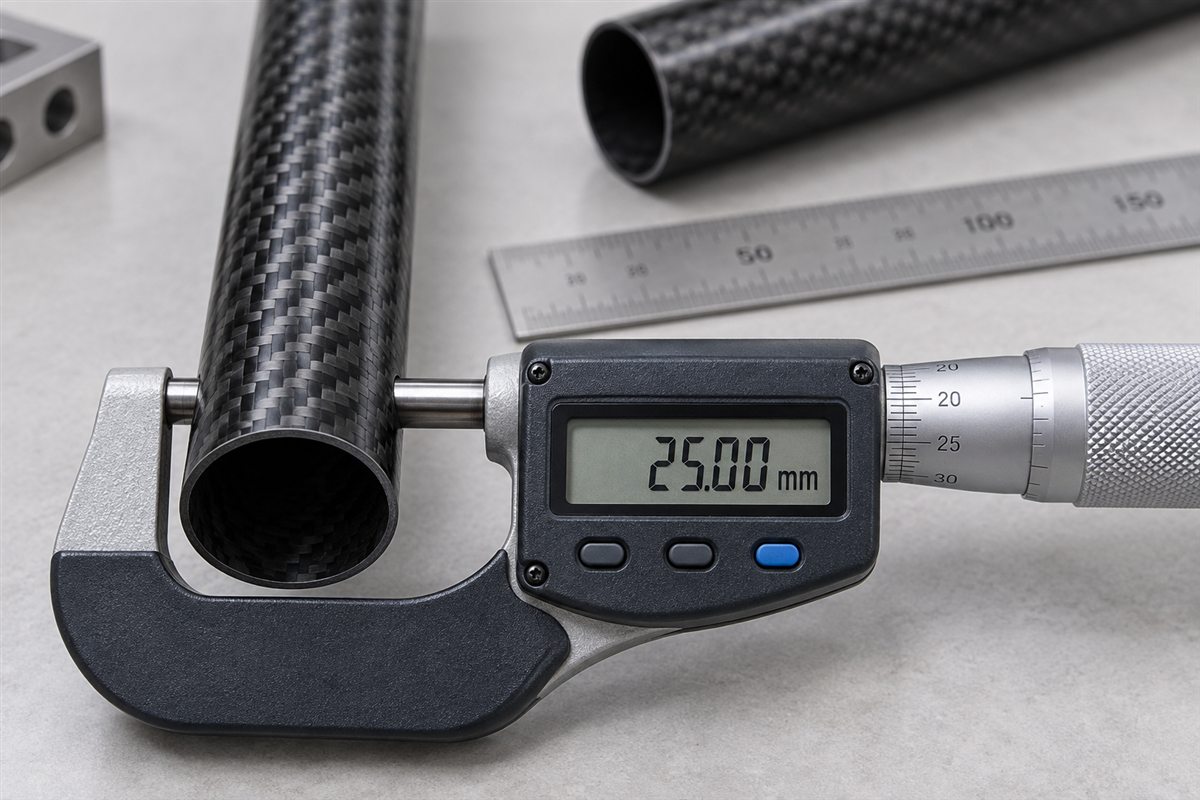
Carbon fiber inspection requirements should identify the features that control assembly and performance, together with the method used to check them. A general request for “high precision” does not define how a part should be accepted.
For a carbon fiber tube, the outside diameter may control a clamp fit while the inside diameter controls a bonded insert. For a machined plate, hole spacing and datum locations may matter more than the outside contour.
These requirements provide a common reference for quotation, manufacturing and acceptance. Explore engineering and drawing-review support →
Different product forms require different controls. The inspection plan should follow the selected manufacturing route and identify where a check provides useful information.
Items to address: Material identification, specified reinforcement and resin, and applicable storage or handling requirements.
Purpose: Keep material selection consistent with the approved specification.
Items to address: Relevant layup, tooling and process requirements.
Purpose: Control features that may become difficult to assess after forming.
Items to address: Part orientation, datums, holes, slots, edges and remaining wall sections.
Purpose: Check drawing-defined geometry and machining condition.
Items to address: Insert position, fitting orientation and completed assembly dimensions.
Purpose: Verify the interfaces used during installation.
Items to address: Agreed dimensions, appearance, identification and protection.
Purpose: Review the finished delivery against the agreed requirements.
The checkpoints and records applicable to an order should be confirmed for that project.
Tube and rod inspection begins with the intended connection and load path. A nominal diameter alone may not adequately define a component that must slide, clamp, bond or align with another part.
For square, rectangular or other shaped sections, identify the datum faces and dimensions that control the mating component. For telescopic parts, define the required fit between sections rather than specifying each tube independently.
Sheet inspection should distinguish between an uncut blank and a finished component. Thickness, flatness and surface requirements may need different acceptance criteria depending on how the material will be supported and used.
Features to define include panel dimensions, thickness measurement locations, edge condition, visible surfaces and any specified fiber-direction reference.
Sandwich panels also require clear requirements for the face skins, core, edge closeouts and attachment areas. Overall thickness alone does not fully describe the panel construction.
For machined parts, inspection should follow the drawing’s datum scheme. Hole locations must be related to the surfaces or features that actually locate the component in the assembly.
Typical priorities include hole diameter and spacing, slots, countersinks, pockets, outer profiles and edge condition. Where fit is critical, provide the mating-part drawing or an agreed checking method.
A completed assembly needs dimensions that extend from one interface to the other. Cut-tube length does not establish the final length after fittings, shoulders or inserts are added.
Inspection requirements may address overall length, fitting position, angular orientation and alignment. Where joint performance requires validation, the test method and acceptance criteria should be agreed separately.
Carbon fiber appearance should be defined for the surfaces that matter to the application.
Identify visible faces, bonding areas, machined edges and concealed surfaces on the drawing. Where appearance is important, an approved reference sample or agreed photographs can help communicate expectations for weave appearance, coating and finish.
Visual checks can address surface marks, exposed fibers, edge breakout, visible cracks and finish consistency. However, appearance alone cannot establish internal laminate quality or confirm structural performance.
Cosmetic acceptance and functional acceptance should be specified separately.
A dimension is only useful when both parties understand how it will be measured.
Flexible sheets and long, slender tubes can respond to support conditions and measuring force. Drawings should identify measurement locations, reference surfaces and any relevant fixture or support arrangement.
For demanding fit requirements, agree on a practical inspection method before production. This helps avoid differences between the way a part is checked at the factory and the way it is checked during customer assembly.
If your order requires a carbon fiber inspection report, specify the dimensions to be recorded, the drawing revision and the reporting format before production.
Items to discuss include:
The format, scope and availability of these documents should be confirmed before ordering. Where carbon fiber batch traceability is required, define which material, production and delivery records need to be linked.
Sample approval should also identify which drawing revision and acceptance requirements apply to subsequent production.
Dimensional and visual inspection do not replace mechanical qualification.
Applications involving significant bending, torsion, bonded-joint loads, fatigue or environmental exposure may require additional testing. The requirement should define the specimen or assembly, loading conditions, number of samples and acceptance criteria.
Any specialist testing needs to be reviewed for feasibility, execution arrangements, cost and lead time. A general material datasheet should not be treated as a test result for the finished component.
Send your drawing, application, quantity and critical acceptance requirements. Include the mating interfaces and any inspection-report or testing needs.
Carbosources can review these inputs alongside the proposed manufacturing route so the quotation addresses both the component and how it will be accepted.