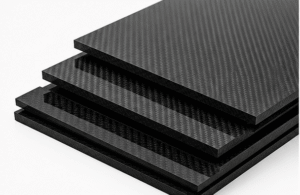
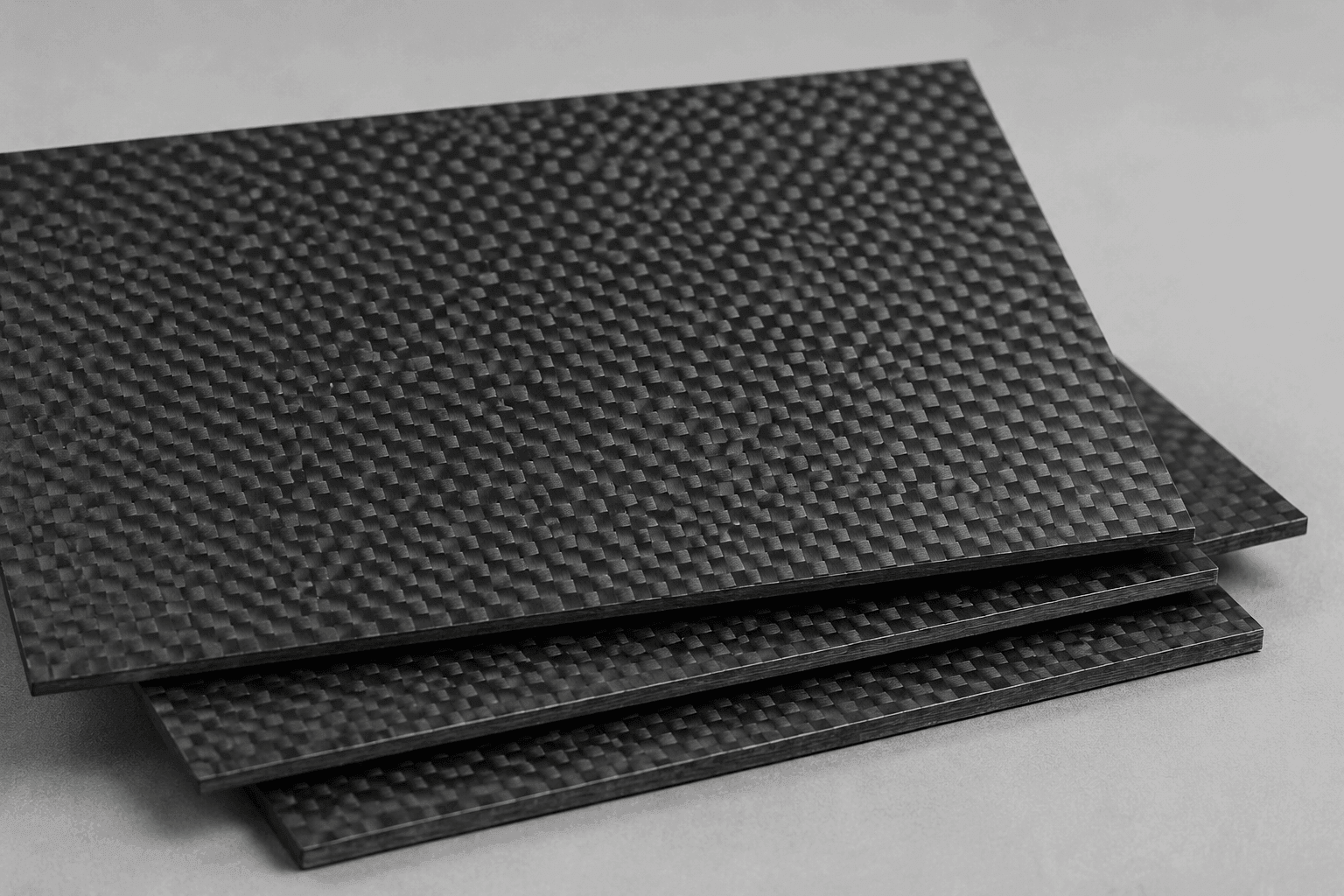
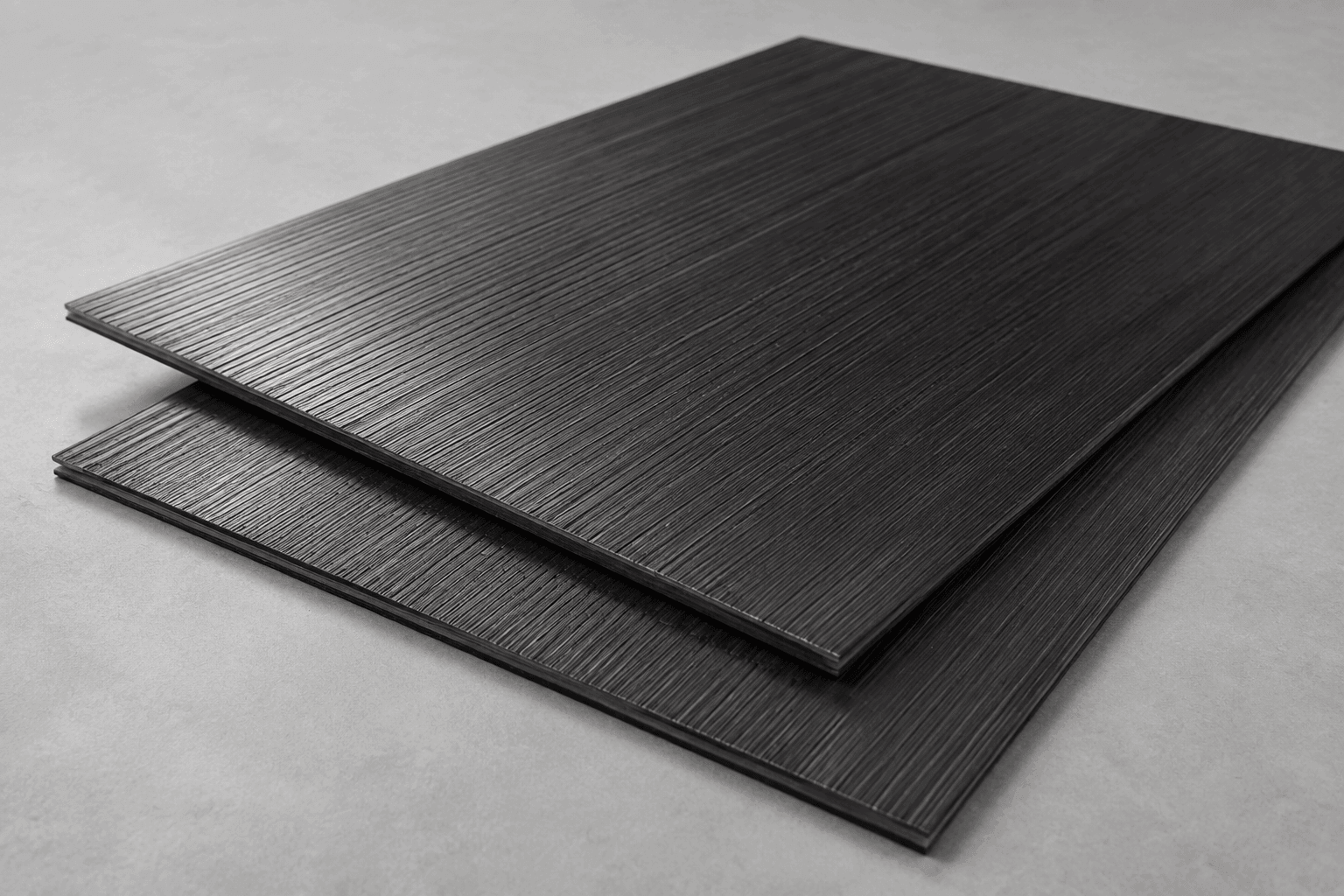
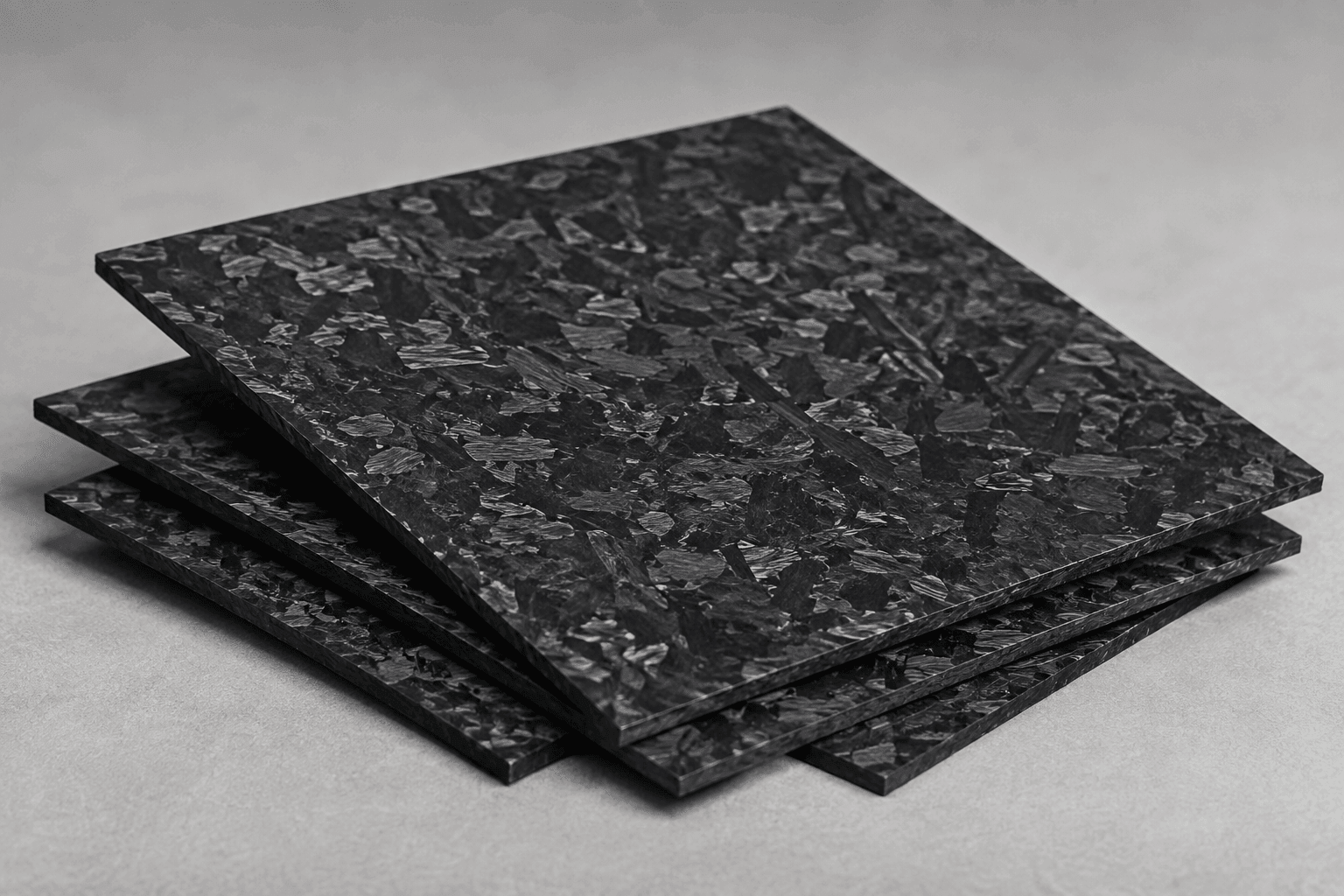
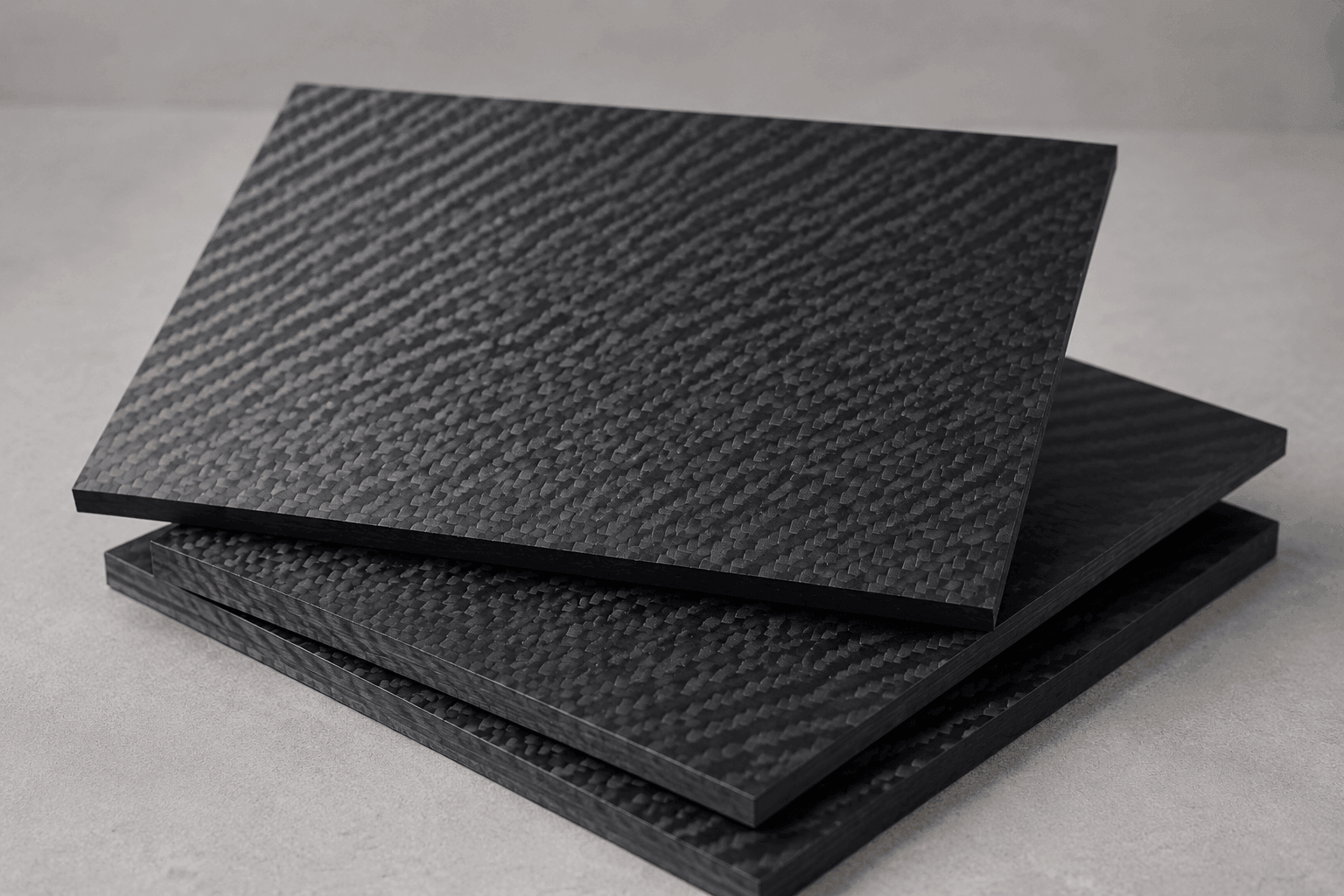
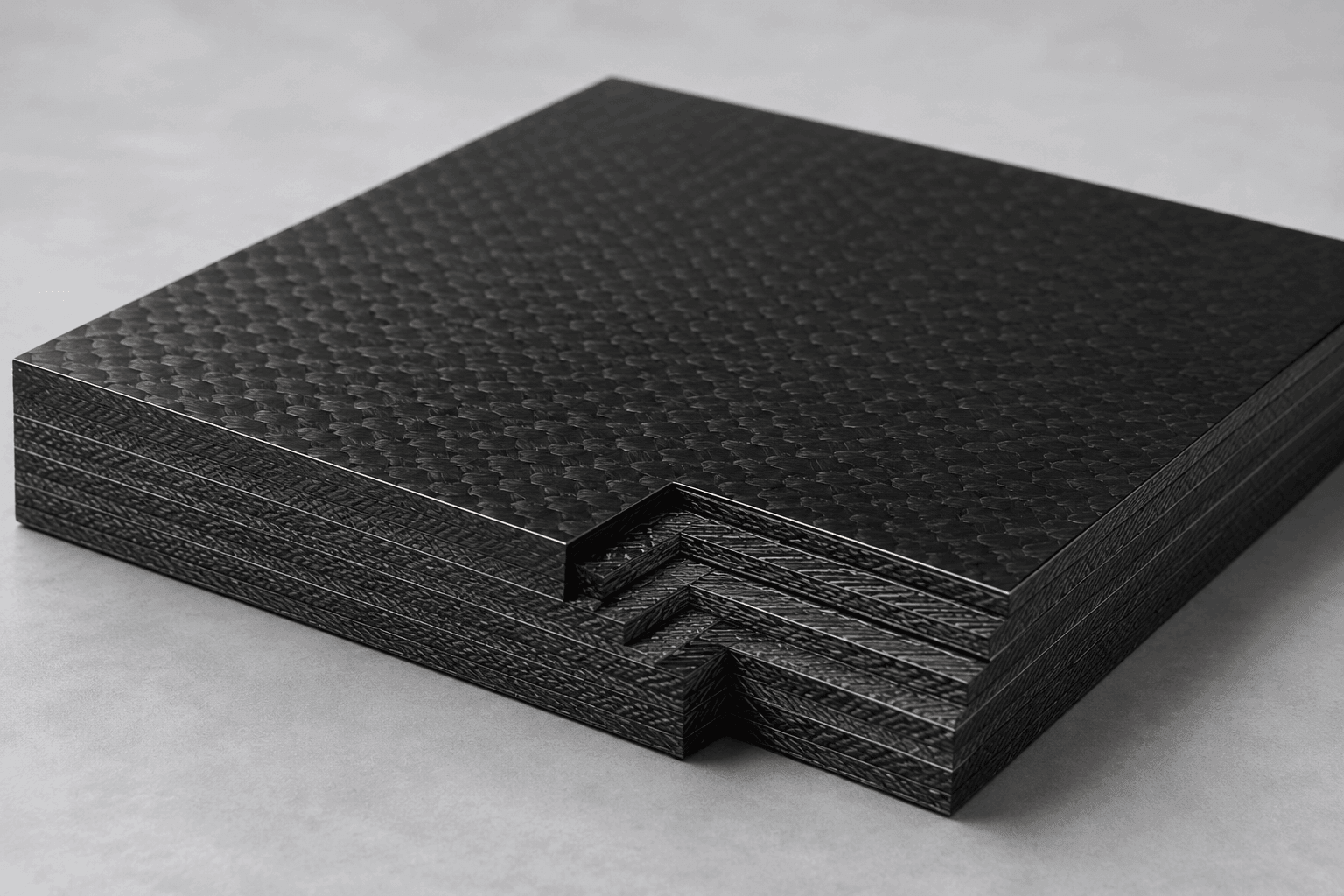
High-performance carbon fiber sheets and plates manufactured with custom thickness, laminate structure, fiber orientation and precision CNC machining for industrial and OEM applications.
Carbosources manufactures carbon fiber sheets and plates using carbon fiber reinforcement and high-performance epoxy resin systems. Controlled layup, compression and curing produce lightweight laminates with high stiffness, dimensional stability and consistent surface quality.
Customers can specify thickness, dimensions, weave pattern, fiber orientation, glossy or matte finish, tolerance, CNC cutting, drilled holes and edge preparation. We support prototypes, small batches and repeat OEM production.
High Strength
High specific strength and stiffness
Lightweight
Lower structural mass
Corrosion Resistant
Stable in demanding environments
Custom Sizes
Thickness, dimensions and machining
What Are Carbon Fiber Sheets?
Carbon fiber sheets are flat composite panels produced by layering woven carbon fiber fabric or unidirectional reinforcement with an epoxy resin matrix. The laminate is compressed and cured to form a rigid, durable sheet.
Compared with aluminum and conventional materials, carbon fiber sheets provide high stiffness-to-weight performance, corrosion resistance, low thermal expansion and excellent fatigue life.
Lightweight structural performance
High rigidity and dimensional stability
Multiple weaves, thicknesses and layups
Suitable for precision CNC machining
As a custom carbon fiber sheet manufacturer and supplier, Carbosources supports prototypes, small-batch orders and repeat OEM production. Sheets can be supplied in custom dimensions, thicknesses, layups and surface finishes, with optional CNC cutting, drilling and edge finishing.
Lightweight Structural Performance
Reduce weight while maintaining strength
High Rigidity
Stable structures and precision panels
Precision Machinability
Accurate holes, contours and features
Choose a Carbon Fiber Sheet for Your Part
Start with the job the sheet must do, then define the laminate, thickness, finish and machining requirements. Appearance alone does not establish structural performance.
Rigid Mounting Plates
Define loads, supported span, thickness, mounting holes and the datum scheme before selecting a laminate or machining route.
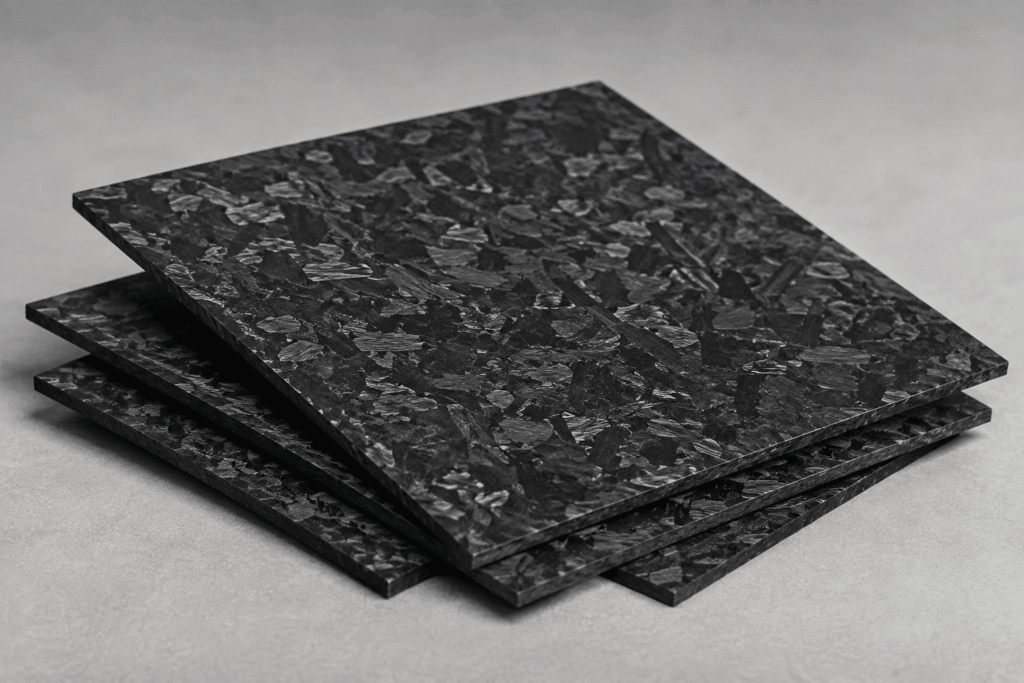
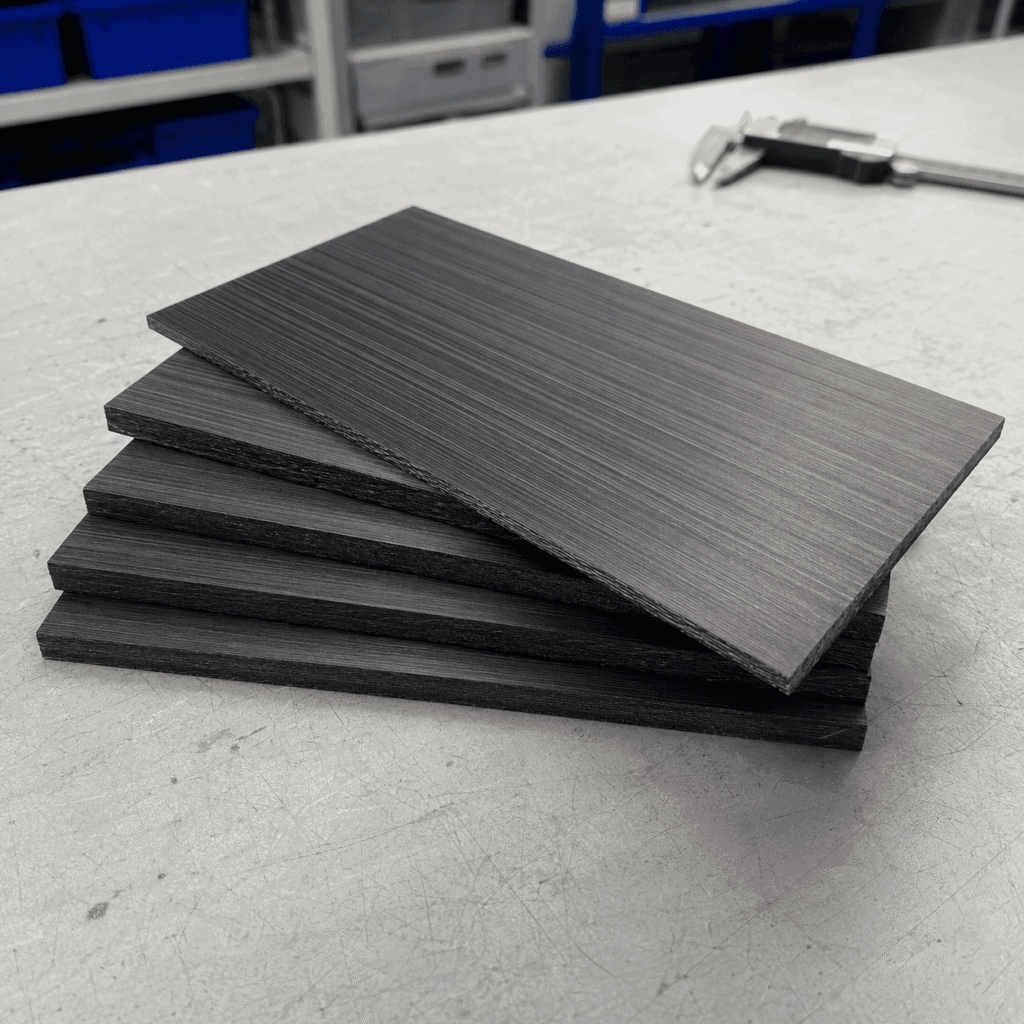
Custom forged carbon fiber sheets and plates supplied in project-specific dimensions, thicknesses and finishes, with drawing-based CNC machining for OEM panels and components.
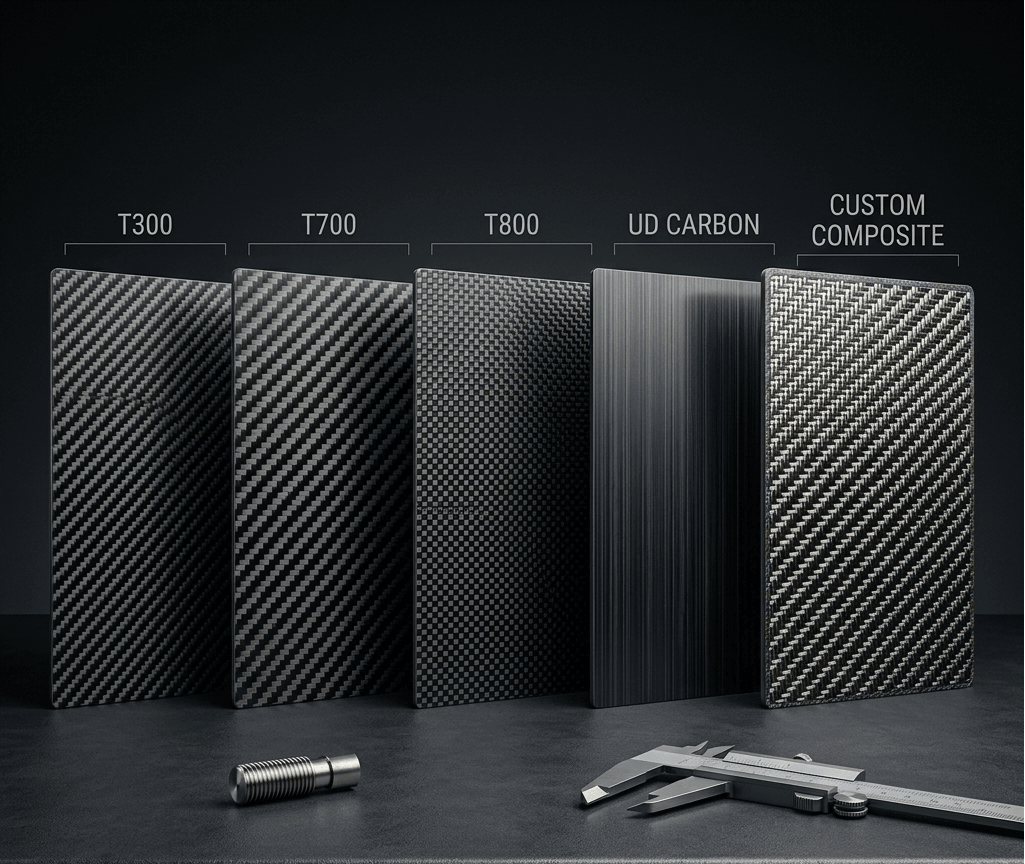
Custom unidirectional carbon fiber sheets and 0° UD plates with tailored thickness, fiber orientation, T300 or T700 options and CNC cutting for structural OEM applications.
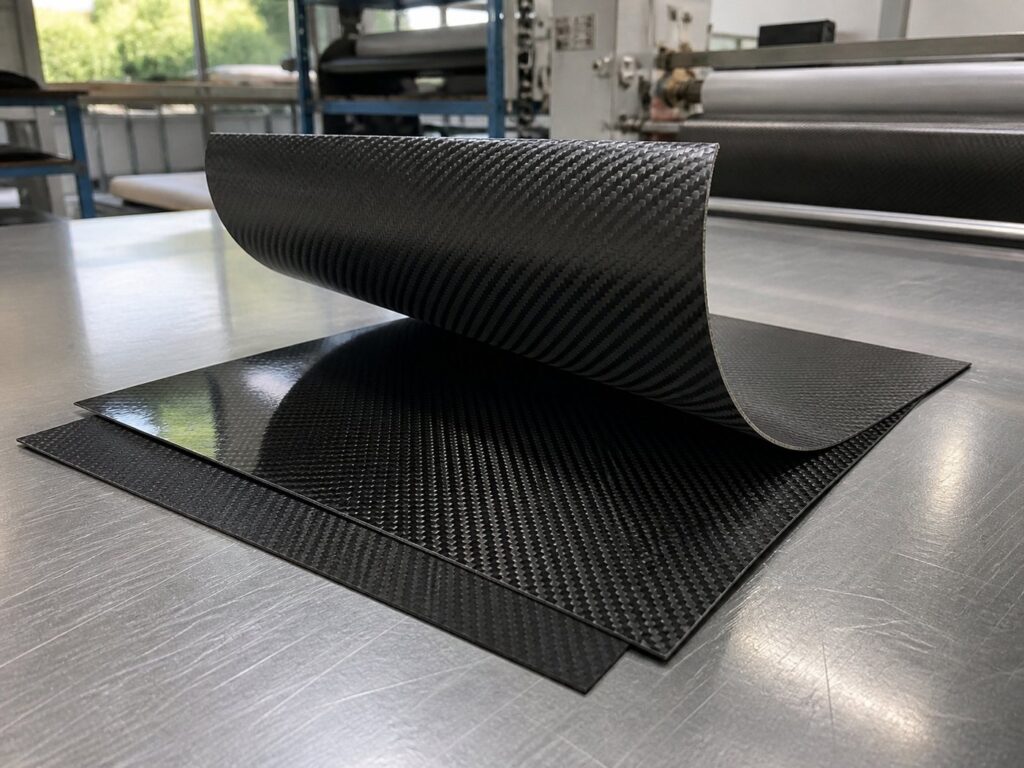
Custom flexible carbon fiber sheets and real CFRP veneer for curved surfaces, available in ultra-thin, matte, glossy and adhesive-backed options with custom cutting for OEM projects.
Weave describes woven reinforcement, such as plain or twill. Laminate construction describes the fiber directions through the thickness, including UD and multi-directional arrangements. Matte and glossy describe surface finish. Specify these separately rather than treating one choice as a complete material specification.
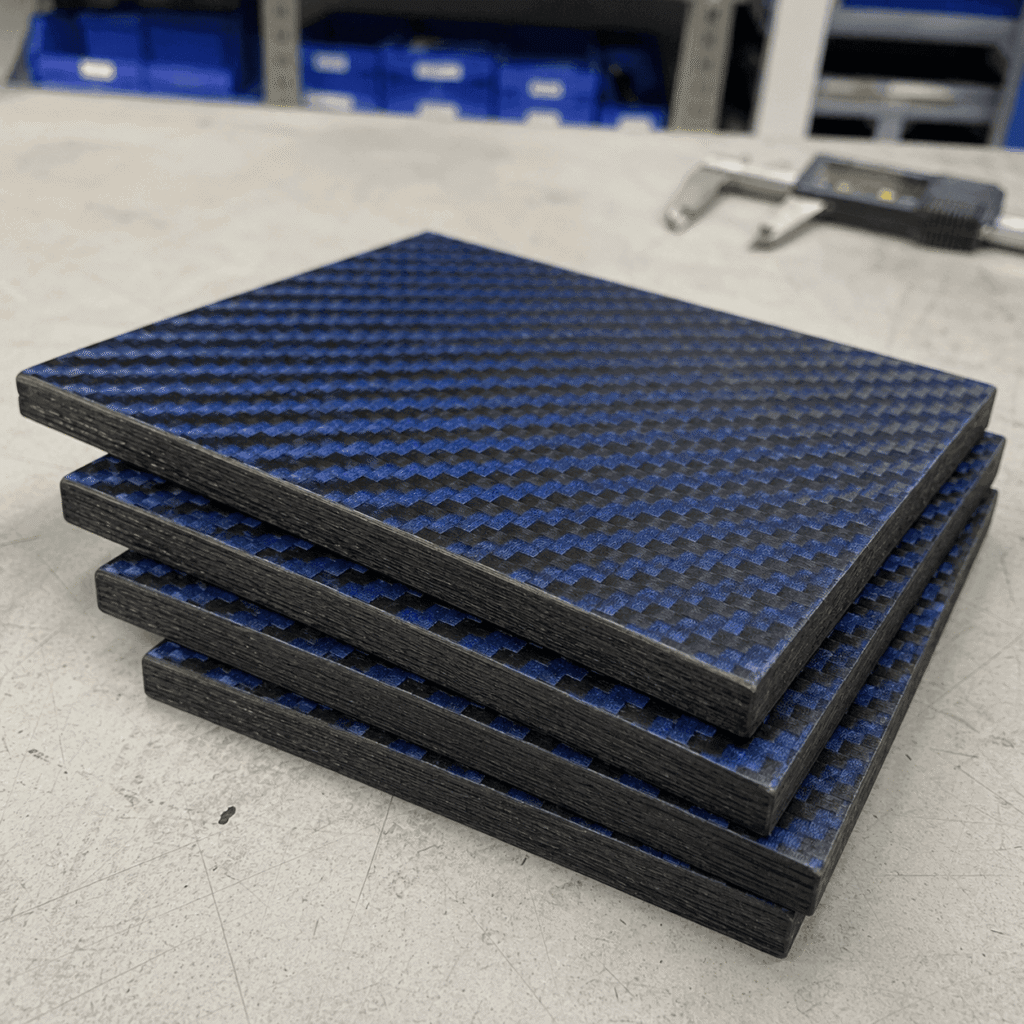
3K Twill Carbon Fiber Sheets
Classic diagonal weave with balanced structural and cosmetic performance.
3K Plain Carbon Fiber Sheets
Uniform basket weave for stable appearance and general industrial use.
Unidirectional Carbon Fiber Sheets
Fibers aligned in the primary load direction for maximum directional stiffness.
Forged Carbon Fiber Sheets
Random chopped-fiber pattern for unique appearance and complex shapes.
Matte Carbon Fiber Sheets
Low-reflection technical surface for modern industrial products.
Quasi-Isotropic Carbon Fiber Plates
Multi-directional layup for balanced in-plane stiffness and structural performance.
Carbon Fiber Sheet Materials, Weave and Layup Options
Available constructions include 3K twill weave, 3K plain weave, unidirectional reinforcement and quasi-isotropic multi-angle layups. Fiber type and orientation control axial stiffness, bending response and in-plane stability.
Epoxy resin systems, surface layers and curing conditions influence temperature capability, moisture resistance and surface quality. Glossy, matte, textured and machined finishes can be supplied for functional or cosmetic applications.
Put Fiber Direction and Inspection on the Drawing
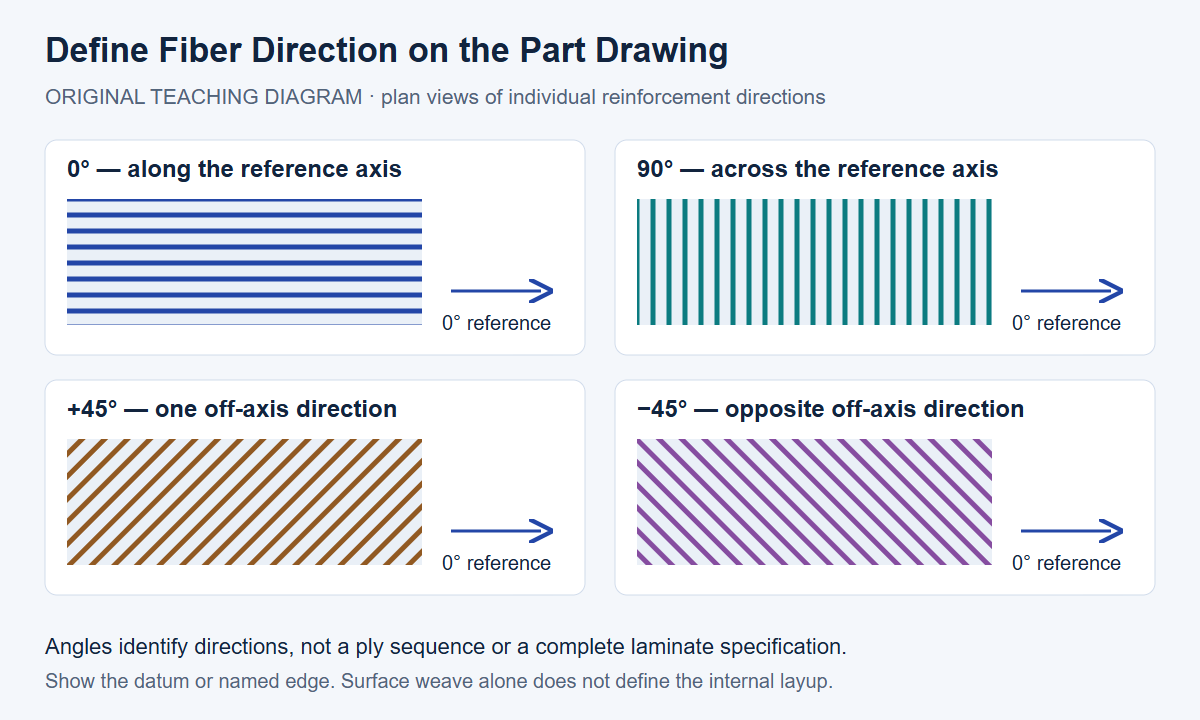
Reference fiber angles to a named edge or datum on the part, not just to the visible twill pattern. A laminate specification also needs the reinforcement, ply sequence and material definition; the four directions below are not a manufacturing recipe.
Original teaching diagram. Directions are referenced to the drawing axis; no ply sequence or finished-part properties are specified.
Reading the directions: 0° follows the reference axis; 90° runs across it; +45° and −45° identify opposite off-axis directions. Surface appearance does not disclose the complete internal layup. A multi-directional laminate must be defined and reviewed as a whole rather than selected from a weave name alone.
Sheet drawing and acceptance checklist
Check
Define the requirement and its evidence
Size
Name length, width and thickness measurement locations. State whether a thickness requirement includes any coating or backing. Identify critical flatness requirements and support conditions.
Layup
Show the 0° reference edge or datum. Provide the approved laminate schedule, or identify the loads and directional stiffness needs still requiring review.
Machining
Locate holes, slots and countersinks from functional datums. Include the mating hardware, critical fits and the required edge condition.
Finish
Mark cosmetic faces and bonding areas separately. Define the surface reference, any coating or backing and the acceptance requirements.
Inspection
Agree which dimensions are recorded, the method and sampling, and the drawing revision used for acceptance. Numerical limits require project review.
Review application, dimensions and performance targets.
2
Material Selection
Select fiber, resin, weave and laminate design.
3
Layup Preparation
Prepare layers according to orientation and stacking sequence.
4
Compression & Curing
Apply controlled heat and pressure for consolidation.
5
CNC Machining
Cut profiles, drill holes and machine features.
6
Quality Inspection
Inspect dimensions, surface and documentation.
Custom Carbon Fiber Sheet and Plate Solutions
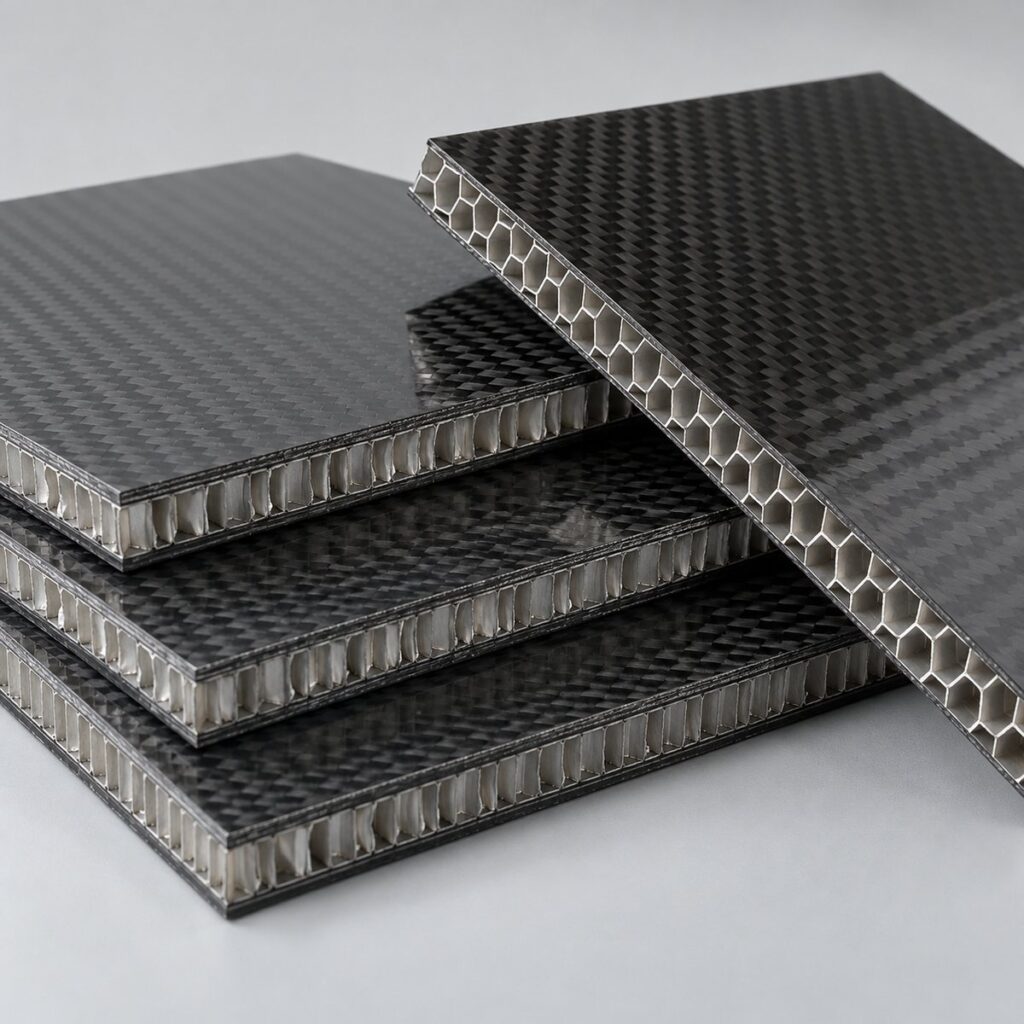
We manufacture custom carbon fiber sheets and plates for both lightweight panels and thicker structural components. Projects can be supplied as full sheets or CNC-machined, assembly-ready parts.
Custom thickness, dimensions and fiber orientation
3K twill, plain, UD and quasi-isotropic layups
Glossy, matte and project-specific surfaces
Drawing-based tolerances and CNC machining
Holes, slots, countersinks and finished edges
Prototype through repeat OEM production
Carbon Fiber Sheet Specifications
Material: Carbon fiber reinforcement with an epoxy resin system
Reinforcement and layup: Woven, UD or multi-directional construction, defined for the project
Thickness: Specified for the application and reviewed with laminate and machining requirements
Dimensions: Drawing-based length, width and usable area
Surface: Glossy, matte or ground finish, with the required faces identified
Processing: Cutting, drilling and milling to the agreed drawing
Acceptance: Critical dimensions, datum references and inspection requirements agreed before production
Carbon Fiber Sheet Applications
Aerospace panels and brackets
Automotive lightweight components
Drones, robotics and automation
Electronics enclosures and heat spreaders
Sports equipment and marine structures
Custom industrial machinery
Quality Control & Testing
Dimensional and flatness inspection
Visual and surface-quality inspection
Fiber orientation verification
Mechanical testing when required
Material certification and traceability
Final inspection reports
Carbon Fiber Sheets vs Carbon Fiber Plates
Carbon fiber sheets and plates use similar composite materials but differ in thickness, stiffness, machining capability and typical application. Thin sheets suit covers and lightweight panels, while thicker plates support structural fixtures and heavily machined components.
Select the sheet according to load direction, bending span, stiffness target and acceptable weight. Thickness and fiber orientation have a major influence on structural performance.
Hole patterns, edge distance, fasteners and inserts should be reviewed to reduce local stress and delamination. Surface finish, temperature, moisture, chemicals, UV exposure, tolerance and production quantity should also be included in the specification.
Carbon Fiber Sheets vs Aluminum Sheets
Carbon fiber sheets provide a higher stiffness-to-weight ratio, lower density and better corrosion resistance than aluminum. Aluminum remains useful where isotropic strength, electrical conductivity, impact behavior or lower material cost is more important.