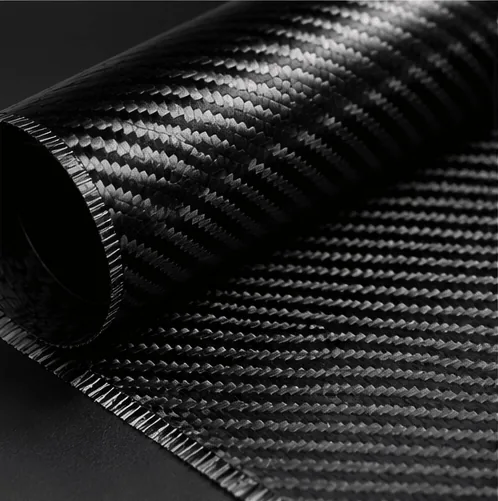
MATERIALS EXPLAINED
3K describes a fiber bundle. Twill describes a weave. Layup describes a stack of layers. These terms belong to different levels of a carbon fiber material description. Understanding the distinction helps you read a specification without confusing appearance, construction and performance.
This guide moves from individual filaments to woven fabric and then to a cured sheet. The aim is to identify what each label tells you—and what remains unknown even when the label sounds detailed.
| Term | What it describes | What it does not establish |
|---|---|---|
| 3K / 6K / 12K | Filament count in a tow | Sheet thickness or strength grade |
| Plain / 2×2 twill | Warp–weft interlacing pattern | The complete laminate |
| Layup | Layer materials, directions and order | A performance guarantee without material and test context |
What Does 3K Carbon Fiber Mean?
A filament is an individual carbon fiber. A tow is a bundle of filaments. The K designation expresses the nominal number of filaments in thousands: a 3K tow contains about 3,000 filaments. It does not mean three layers, 3mm thickness or a third-level quality rating.
Keep tow size separate from fiber grade. For example, a manufacturer’s designation can identify the fiber type, filament count and sizing as separate fields. Toray’s T300 data sheet illustrates that distinction. Its published fiber properties are not automatically the properties of a finished plate made using that fiber.
3K, 6K and 12K Carbon Fiber: What Changes?
| Tow label | Nominal filament count | Read it as |
|---|---|---|
| 3K | 3,000 | A bundle-count description |
| 6K | 6,000 | Twice the count of a 3K tow |
| 12K | 12,000 | Four times the count of a 3K tow |
When comparing carbon fiber—3K, 6K and 12K—the count is only one variable. Bundle spreading, yarn spacing and fabric construction also matter. Do not infer fabric thickness, weave-cell dimensions or finished weight from the K number alone.
A 12K tow contains more filaments than a 3K tow, but that does not make every 12K sheet stronger than every 3K sheet. A meaningful comparison needs the fiber grade, laminate architecture, resin, fiber content and the direction and method of testing. There is no universal performance ranking of 3K, 6K and 12K carbon fiber.
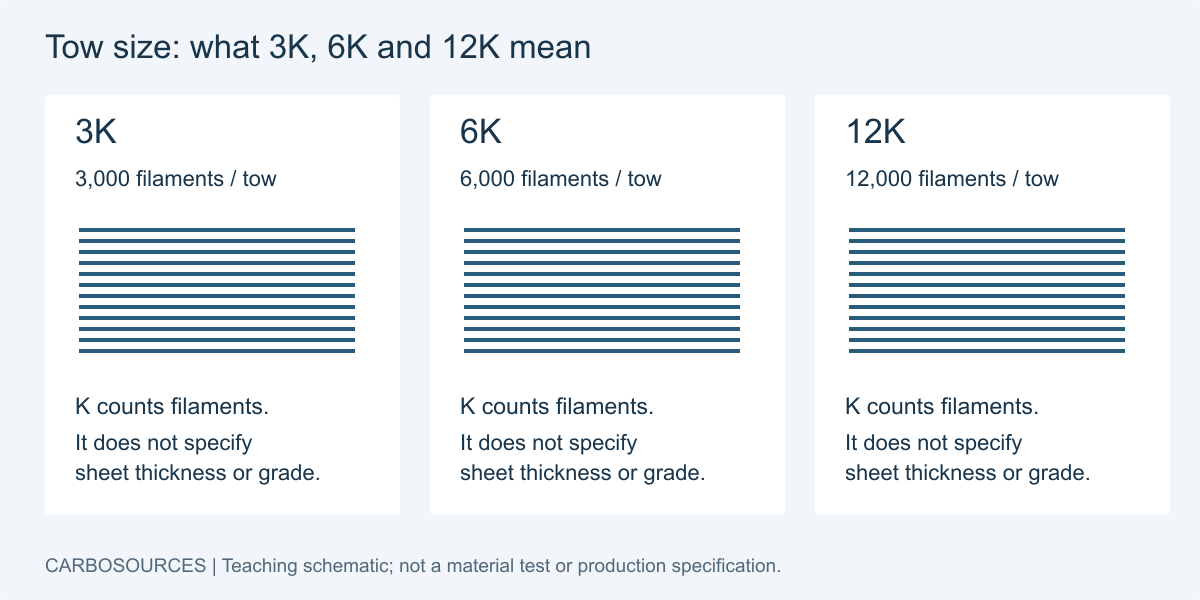
Figure 1. Tow labels describe filament counts. Lines are symbols, not literal filament counts; bundle widths are not drawn to scale.
What Is 3K 2×2 Twill Weave Carbon Fiber Fabric?
The phrase 3K 2 x 2 twill weave carbon fiber fabric combines several independent pieces of information. “3K” identifies the tow size; “2×2 twill” identifies the interlacing repeat; “carbon fiber” identifies the reinforcement; “fabric” identifies its textile form.
In a regular 2×2 twill, a warp yarn passes over two weft yarns and under two. The pattern shifts along neighboring yarns, creating the familiar diagonal appearance. The diagonal visual pattern does not mean all fibers run diagonally: the fabric still has warp and weft directions.
Also check areal weight, normally expressed in g/m². This is a separate specification, not a number derived from 3K. A fabric listing should distinguish its textile data from any cured-laminate information. The Easy Composites twill fabric specification, for example, lists filament count, weave and areal weight separately.
3K Plain Weave Carbon Fiber vs. 2×2 Twill
In 3K plain weave carbon fiber, warp and weft alternate over one and under one, producing a checkerboard-like pattern. Both plain and twill fabrics can use 3K tows: choosing the weave does not change what 3K means.
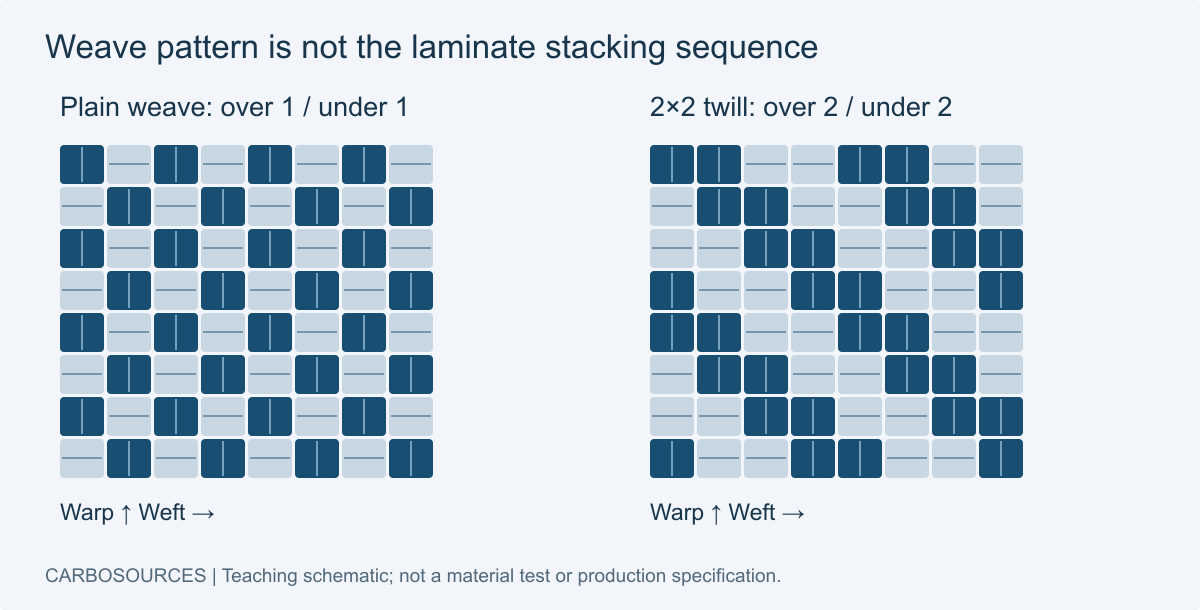
Figure 2. Top-view weave schematic. Dark cells show warp on top; light cells show weft on top. The graphic illustrates interlacing, not actual yarn size.
| Feature | Plain weave | 2×2 twill |
|---|---|---|
| Basic repeat | Over 1 / under 1 | Over 2 / under 2 |
| Visible pattern | Checkerboard-like | Diagonal ribs |
| Handling tendency | Generally more stable | Generally easier to drape |
| Performance conclusion | Requires material and laminate data | Requires material and laminate data |
Drape means how readily an uncured fabric conforms to a shape. It is not the flexibility of the finished cured sheet. Gurit’s Guide to Composites discusses weave stability, drape and fiber crimp. Those trade-offs do not justify declaring every twill plate stronger than every plain-weave plate.
From Fabric to Sheet: Understanding Carbon Fiber Layup
Dry cloth is reinforcement, not yet a rigid plate. A laminate combines layers with a matrix, commonly a resin system. Prepreg already contains resin; a cured sheet has undergone the relevant forming and curing process. Identify which material form a specification describes before comparing values.
A layup records the layers and their arrangement through the thickness. A woven surface may sit over woven, unidirectional or other specified internal layers. A photograph of the top face cannot reveal the full stack.
Reading a simple stacking sequence
Consider the teaching example [0 / +45 / −45 / 90]s for identical unidirectional plies. Angles refer to a defined reference axis. The “s” means the listed half-stack is mirrored, giving eight plies: 0, +45, −45, 90, 90, −45, +45, 0 degrees.
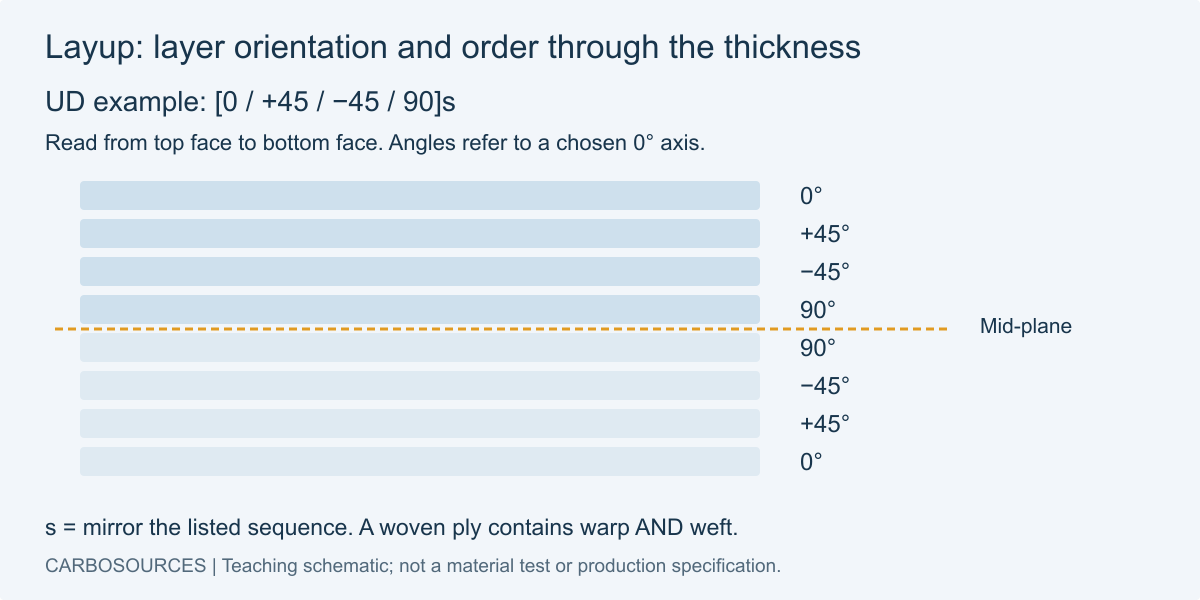
Figure 3. An illustrative UD stacking sequence, not a Carbosources production recipe. The same drawing convention must not be read as a single fiber direction for a woven ply.
A woven ply contains both warp and weft. Rotating a conventional 0°/90° woven ply by 45° rotates both yarn systems. Always check whether a layer label refers to UD reinforcement or a fabric and how its orientation is defined.
Symmetric, balanced and quasi-isotropic
These terms answer different questions. Symmetric refers to matching layers across the mid-plane. In a UD layup, balanced commonly means matching +θ and −θ layers of the same material and thickness. Quasi-isotropic describes a particular in-plane elastic response; it does not mean identical strength and bending behavior in every direction. CKN’s laminate mechanics reference provides the underlying framework.
Why Similar-Looking Sheets Can Behave Differently
Imagine two sheets with the same 3K twill outer face and nominal thickness. One has a different internal reinforcement orientation from the other. The visible descriptions match, but the descriptions do not establish equal properties. This is a hypothetical comparison, not a test result.
Even a quoted modulus needs context: is it fiber tensile modulus, laminate tensile modulus or a flexural measurement? Which direction was tested? What was the specimen and test method? Comparing numbers without those labels can create an apparent difference—or similarity—that is not useful.
How to Read a Carbon Fiber Sheet Specification
Take this illustrative label: 3K / 2×2 twill / carbon–epoxy / 2mm / matte. Read it in stages instead of treating it as a complete engineering specification.
| Label | What you know | Still unspecified |
|---|---|---|
| 3K | Tow filament count | Fiber grade |
| 2×2 twill | Named weave pattern | Which layers use it |
| Carbon–epoxy | Reinforcement and matrix families | Resin grade and cure details |
| 2mm | Nominal sheet thickness | Tolerance and ply schedule |
| Matte | Surface appearance | Mechanical properties |
Then look for a layer schedule, material identification and appropriately labelled property data. If those are absent, record them as unknown. Neither a polished product photo nor a longer list of familiar terms fills the gap.
Check Your Understanding
Does 3K mean 3mm?
No. K describes tow filament count; millimeters describe a physical dimension.
Is 12K automatically better than 3K?
No. “Better” needs a defined property and a like-for-like material comparison.
Does a twill surface prove an all-twill laminate?
No. The surface identifies only what is visible; the layer schedule describes the interior.
Can I use cloth thickness to predict a cured sheet exactly?
Not by itself. The material system, number of layers and processing conditions must also be considered.
Remember the sequence: tow → fabric → layup → cured sheet. Each level adds information. Read a material description at the correct level before using it to draw conclusions about a component.
Continue learning: carbon fiber material selection and how sheet thickness relates to part requirements.