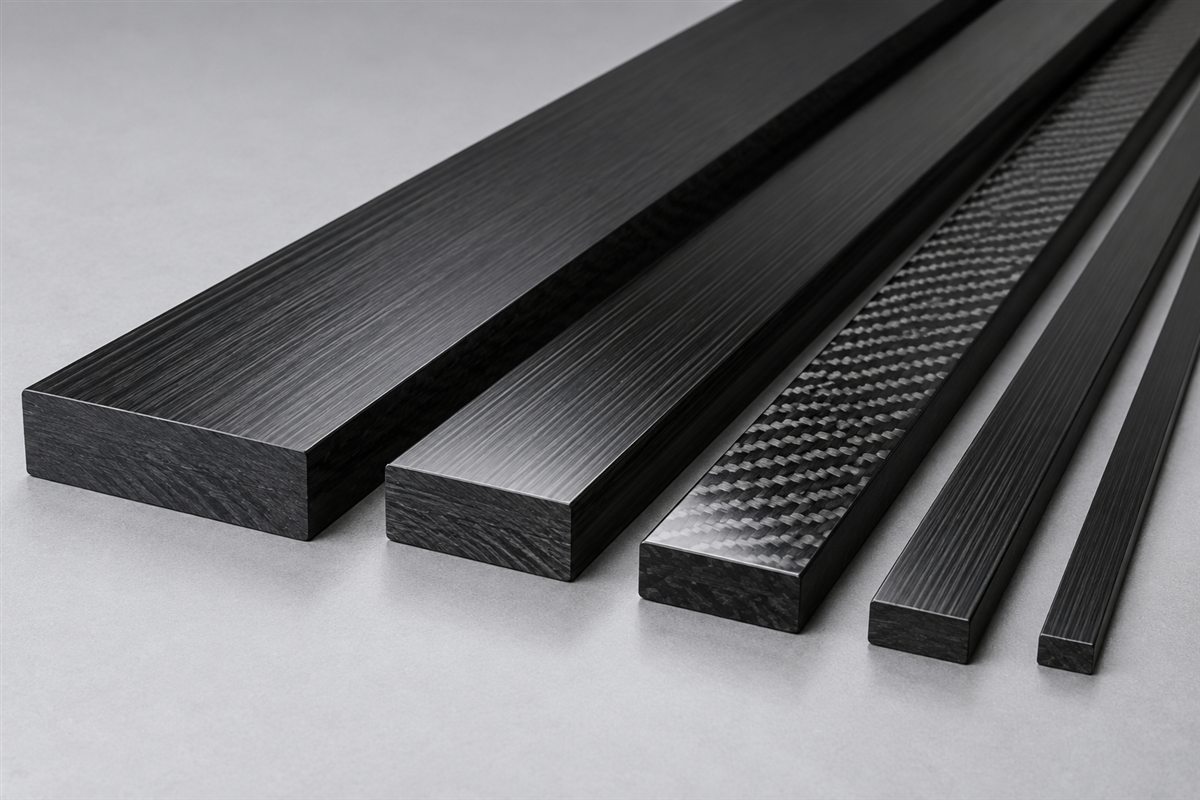
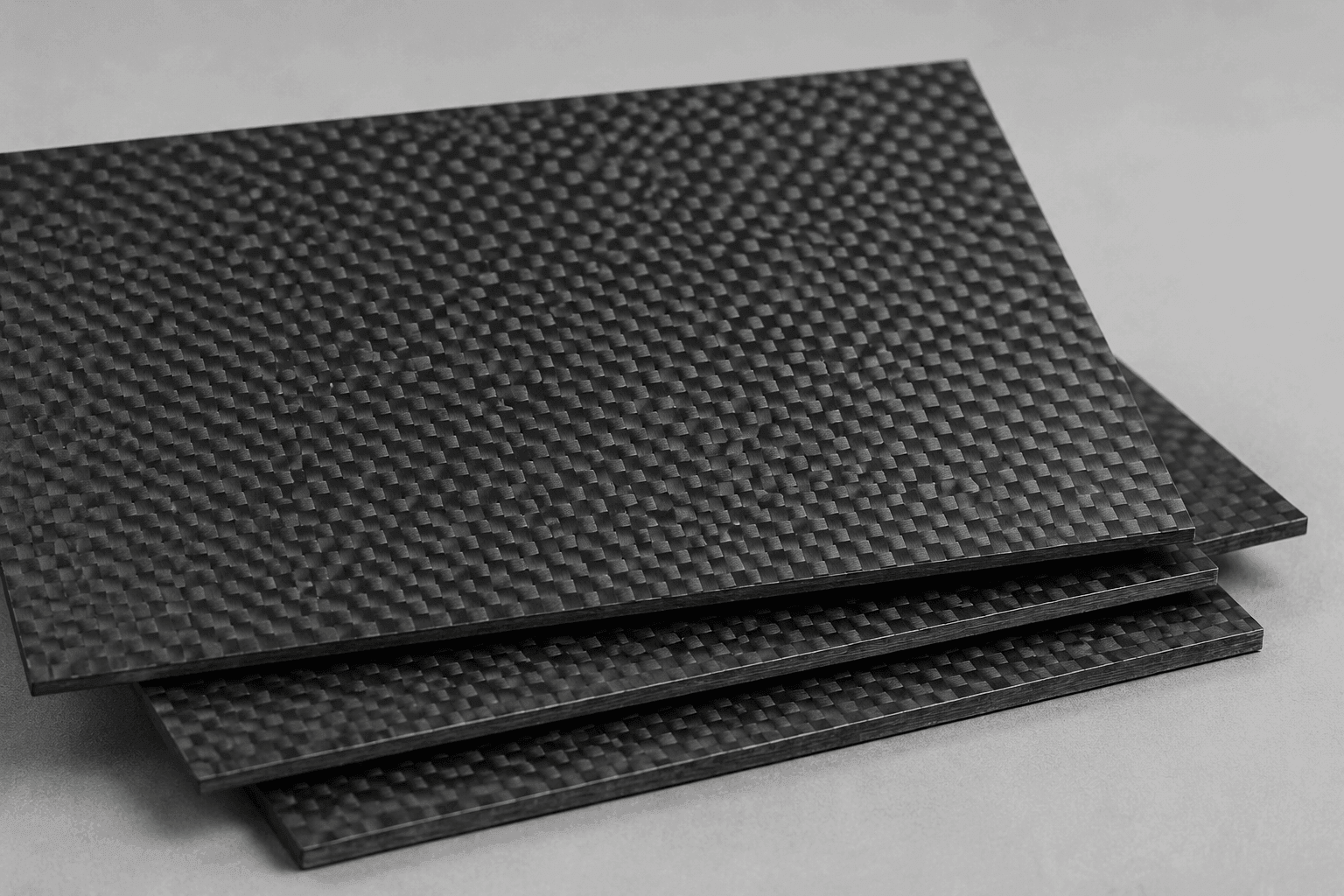
A carbon fiber part may show a diagonal twill pattern, a small plain-weave grid, or almost no visible weave at all. That surface tells you something about its outer layer, but it cannot tell you the complete laminate schedule or how the part will carry a load. The useful comparison is therefore not simply which carbon fiber pattern looks best? It is what must the finished part do, and which reinforcement belongs in each layer?
This guide compares plain weave, 2×2 twill weave and unidirectional (UD) carbon fiber through three practical questions: How does the material conform to the part shape? Which directions contain the principal fibers? What information is still needed before judging the finished laminate?
Start With the Part, Not the Pattern
Before comparing plain weave vs twill weave carbon fiber, separate three decisions:
- Surface geometry: Is the material laid over a flat panel, a single gentle curve, or a shape that curves in two directions?
- Load path: Is the main demand in one direction, several directions, or around local attachments and holes?
- Visible finish: Must the outer surface show a consistent woven pattern, or is the surface hidden or painted?
The answer may point to different materials for the outer layer and the internal layers. A woven face can provide a specified appearance, while other layers address the required load directions. Equally, a part may use woven reinforcement throughout. The choice depends on the complete design, not on a photograph of the surface.
Plain Weave, Twill Weave and UD at a Glance
| Reinforcement | Fiber arrangement | What it can help with | What to check |
|---|---|---|---|
| Plain weave carbon fiber | Tow bundles alternate over and under in two directions | A defined, regular woven pattern and reinforcement in both fabric directions | Whether the cloth can be laid on the actual geometry without wrinkles or distortion |
| 2×2 twill carbon fiber | Tow bundles pass over two and under two, forming a diagonal pattern | A recognizable diagonal finish and greater ability to conform than a comparable plain weave | Whether the pattern remains aligned on visible surfaces and how the laminate is built below it |
| Unidirectional carbon fiber | Most reinforcement runs along one principal direction; light crosswise yarn or binder may hold some formats together | Placing fiber where a defined directional load calls for it | The full set of ply orientations and support for loads outside that direction |
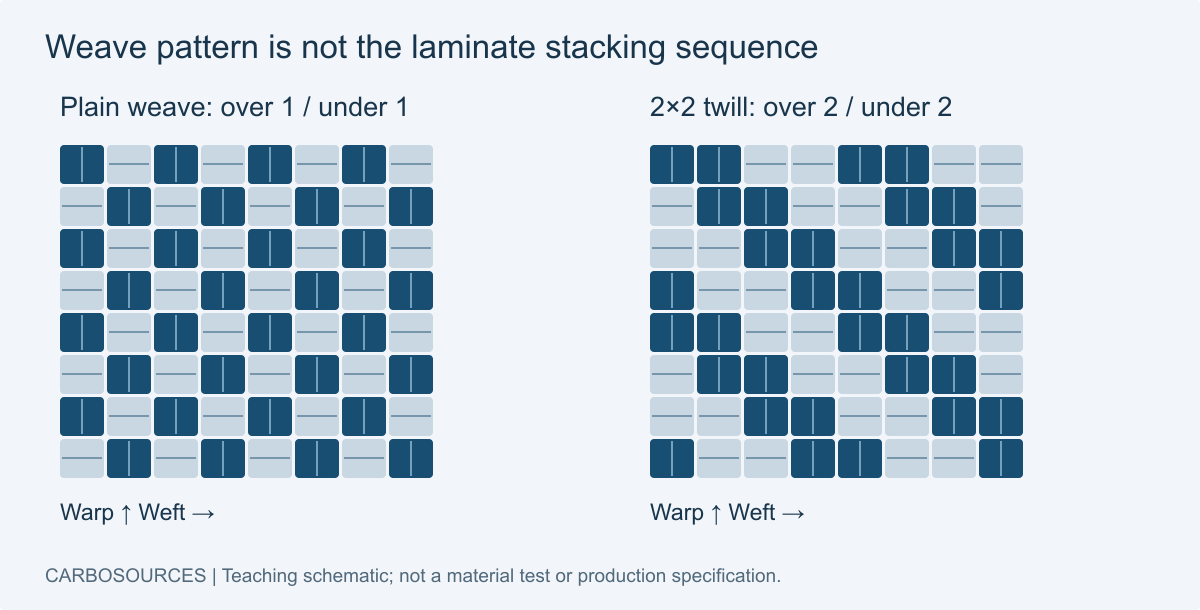
Plain and twill are weave patterns. UD is a different reinforcement architecture, so “UD weave” can be misleading. All three names describe incoming reinforcement, not the properties of a completed part. Fabric weight, fiber grade, resin, fiber volume, ply orientation, consolidation and manufacturing quality also matter.
When Plain Weave Is a Sensible Starting Point
Plain weave interlaces frequently and creates a compact, regular pattern. That can be useful when a woven face must look consistent across a relatively flat region, or when the design calls for fibers in both fabric directions. Its interlacing also means the bundles bend repeatedly over and under one another, a feature known as crimp.
Consider a flat equipment cover with a visible carbon surface. A plain-weave face might be chosen for its small checkerboard appearance. But the face fabric alone does not establish the panel’s bending rigidity. Panel span, thickness, support points and the orientation of every structural layer still have to be considered. A fabric that looks appropriate on a flat coupon may also resist being laid smoothly into a tight double curve.
Selection question: Can a sample of the chosen fabric follow the actual part geometry while keeping the required pattern and avoiding wrinkles?
When 2×2 Twill May Be Easier to Lay Over a Shape
In a 2×2 twill, each tow typically passes over two crossing tows and then under two, producing diagonal ribs. With fewer interlacings than plain weave, a comparable twill fabric generally conforms more readily to curved tooling. Hexcel describes plain weave as having lower drapeability and higher crimp, with twill in an intermediate position among common woven styles.
Imagine an enclosure cover that bends around two axes. A twill outer ply may be easier to position than a comparable plain-weave outer ply, but “more drapable” does not mean it can cover any shape without seams, darts, distortion or wrinkles. Cutting pattern, fiber direction, fabric weight and process still matter. A visible twill face may also make any change in pattern direction easy to notice.
Twill is often selected for appearance, yet its diagonal surface is not proof that the internal laminate is all twill. It is especially important to separate the visual decision from the structural one when reading a product description or requesting a comparison.
Selection question: Is the priority a particular visible pattern, easier placement over the geometry, or a structural requirement that needs its own laminate review?
When Unidirectional Carbon Fiber Deserves Attention
UD reinforcement concentrates fibers along a chosen direction. That is valuable when the part has a well-defined load path and the designer wants to place reinforcement along it. The advantage is directional; it is not a claim that a single UD ply is best for every component.
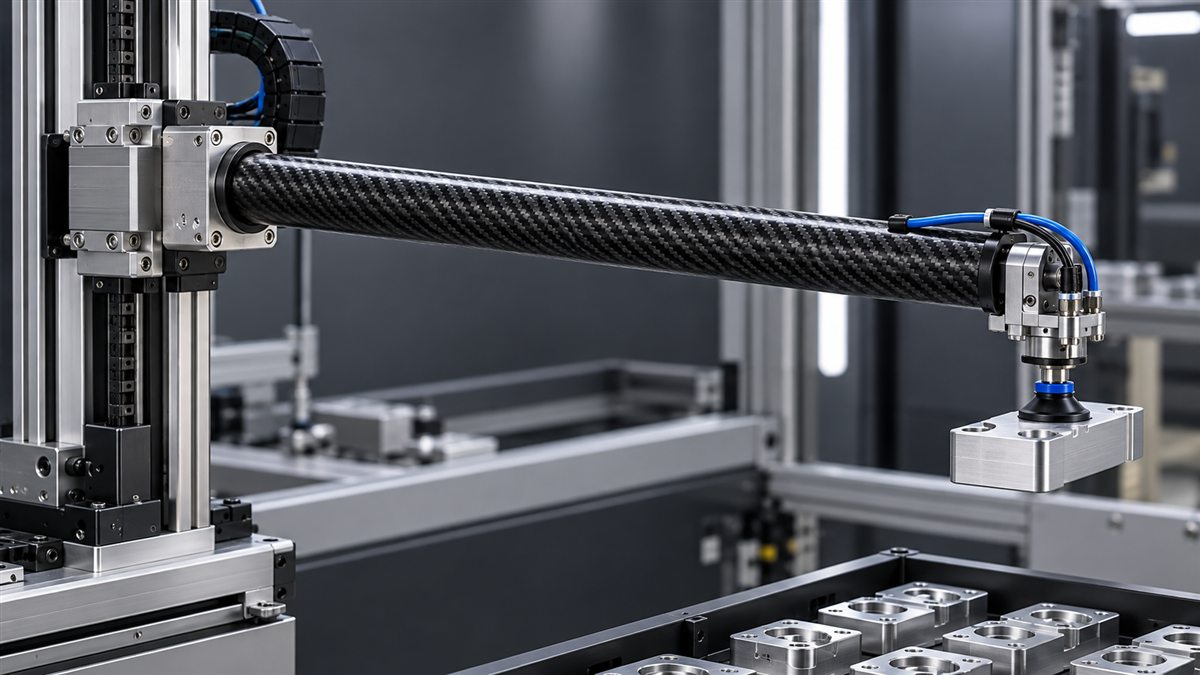
Consider a long member that primarily bends along its length. Longitudinal UD plies may be relevant to that design. The member may also experience twisting, local bearing near fasteners, handling loads or loads introduced from another direction. Those requirements can change the ply schedule and may call for additional orientations or different local details. A stack of only longitudinal plies should never be assumed appropriate just because the primary load is longitudinal.
UD can also appear beneath a woven face. For example, a specification might call for a particular surface pattern while the internal layers are oriented to meet calculated loads. That is a possible design arrangement, not a universal production recipe or a claim about a particular Carbosources product.
Selection question: Which load direction is actually known, and what other directions or interfaces must the complete laminate handle?
Three Worked Selection Scenarios
The following are teaching examples, not tested designs or fixed material recommendations.
1. A flat visible panel
The buyer wants a uniform carbon appearance on a panel supported around its edges. Plain weave and twill could both be considered for the visible face. The next questions concern the desired pattern, support span, target thickness, mounting points and allowable deflection. The face fabric should not be used as a shortcut for predicting finished-panel stiffness. For the dimensional side of this decision, see our carbon fiber sheet thickness guide.
2. A cover with compound curvature
The surface curves in two directions and the carbon pattern remains exposed. A comparable twill may conform more readily than plain weave, so it is a useful candidate for a layup trial. The trial should check wrinkles, tow distortion, seams and visual continuity before choosing the face fabric. The internal layers still need to be selected according to the loads and process.
3. A long component with a dominant load direction
The load analysis indicates a strong directional requirement. UD reinforcement could be considered along that direction, but the team must also examine torsion, transverse loads and attachment zones. A plain or twill face may be included if a woven appearance is needed; the outer pattern alone cannot verify the component’s load capacity.
What to Compare Before Choosing a Fabric
If you are comparing two candidate reinforcements, keep as many variables as possible the same. A fair comparison should state the fiber grade, areal weight, resin system, fiber orientations, cured thickness and processing route. Comparing a light plain weave with a much heavier twill and attributing every difference to the weave would give the wrong lesson.
For a finished-part decision, record:
- The part geometry, including difficult corners and compound curves.
- The visible-surface requirement and acceptable seams or pattern changes.
- Principal loads, load directions and mounting or attachment points.
- Candidate fabric style and areal weight, plus the full laminate schedule.
- The process and inspection criteria that will be used to assess the part.
If those items are unknown, it is more accurate to describe a material as a candidate than to call it the best choice.
Frequently Asked Questions
Is twill weave stronger than plain weave carbon fiber?
Not as a general rule. Weave changes fiber path and handling, but a finished part’s strength depends on the whole material system, ply schedule, direction of loading and manufacturing quality. Compare actual laminate data under the same test conditions rather than ranking weave names alone.
Is unidirectional carbon fiber a weave?
No. In UD reinforcement, most load-bearing fibers run in one direction. Some formats use a small amount of crosswise yarn or binder to hold the material together, but that does not make UD equivalent to a balanced plain or twill weave.
If a sheet shows twill on the outside, are all layers twill?
No. A visible face identifies only the surface construction. To understand the interior, ask for the laminate schedule or an appropriate material specification. Our guide to 3K, twill and layup explains how to read those terms without confusing them.
Which should I choose for a curved visible part?
A twill face is often worth evaluating because of its drapeability and diagonal appearance. The actual fabric and cutting pattern must still be checked on the part geometry; there is no reliable choice from the words “curved part” alone.
The Useful Rule
Choose the face for the required appearance and ability to follow the shape. Choose the internal reinforcement and fiber directions for the loads the part must carry. Then evaluate the full laminate and manufacturing process together. Plain weave, twill weave and UD are tools for different jobs, and they may appear in the same well-defined design.